
The essential thing in education is not the doctrine taught, it is the awakening.
Quote from Ernest Renan; Memories of childhood and youth (1883)
Welcoming a puppy is much more than offering it a home: it is accompanying it in the discovery of the world and laying the foundations for its future balance.
Socialization and training are the cornerstones of this development. From its first weeks of life, the puppy learns to understand its environment, interpret situations, and interact with humans and other animals. Every experience contributes to shaping the adult it will become.
The first few months are crucial. It is during this period that the puppy develops its confidence, adaptability, and emotional stability. Gradual and positive socialization will allow it to approach new things calmly rather than fearfully.
Training, on the other hand, provides a clear framework. It’s not just about obtaining obedience, but about establishing consistent communication, developing self-control, and strengthening the bond of trust between the dog and its owner.
A puppy that is well cared for will become a balanced dog, capable of living harmoniously in our society.
Discover in videos
Puppies and cardboard video
Puppy massage video
1 – Stimulate the puppy to develop its confidence
Stimulating your puppy from a young age helps it become more confident and self-assured.
Gradually accustom him to everyday noises: clap gently, walk with heavier steps, put on music, vacuum… Always in a gradual and reassuring way.
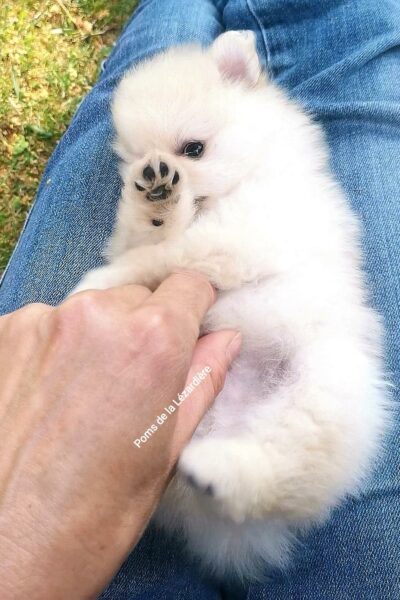
Handle him regularly and gently: pet him, brush him, look at his ears, touch his paws. Play with him, run around for a few moments, share energetic and then calm moments.
Introduce him to the outdoors, meet new people, expose him to diverse environments.
The puppy never stops exploring and learning: this learning continues throughout its life.
Thanks to these positive stimuli, he understands his environment better. He gains confidence and will approach new situations with much less stress.
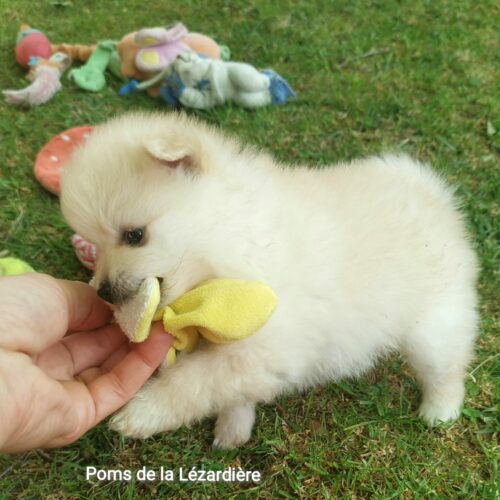
Socialization: the foundation of balance
Socialization is one of the most important foundations in building a balanced dog.
It begins at birth with the mother, continues with the breeder, and then naturally progresses in the adoptive family. Every step counts. Every experience leaves its mark.
A well-socialized puppy learns to understand the world around it:
other dogs, animals, humans, varied environments, noises, new situations.
The more gradual, positive and adapted to his pace his discoveries are, the more he will develop confidence and emotional stability.
Conversely, a lack of socialization or repeated negative experiences can generate fear, stress, or behaviors that are inappropriate in adulthood.
The key remains the same:
gradualness, observation, kindness and consistency.
A puppy gently guided today will become a serene adult dog, capable of adapting to changes and evolving confidently by your side.
Socialization is not a one-off event. It is a learning process that is cultivated throughout life.
2 – Socialising the puppy means helping him discover the world
a – Mother socialisation
b – Socialisation to all types of dogs
c – Socialisation with other animal species
d – Socialisation to all types of humans
e – Socialisation to society
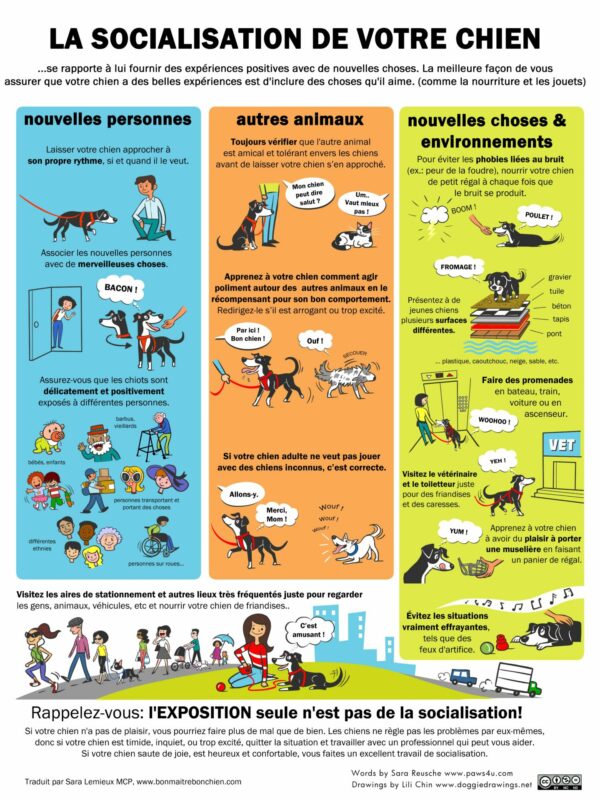
Drawings by Lili Chin. doggiedrawings.net – Words by Sara Reusche. paws4u.com – Traduct in french by Sara Lemieux, MCP. bonmaitrebonchien.com
a – Mother socialisation and then in parallel with the breeder
The socialization of a puppy begins at birth, through contact with its mother. It evolves gradually as it develops its senses: first touch and smell, then sight and finally hearing.
The puppy stays with its mother during its first few weeks of life, ideally for at least 10 weeks. If necessary, it can stay longer, up to 3 months, to complete its training.
The mother plays a fundamental role. She transmits the first codes of canine communication. If a new noise occurs and she remains calm, the puppy understands that there is no danger. She thus helps it to gradually become accustomed to the sounds and stimuli of its environment.
She also teaches him self-control. If the puppy plays too roughly or bites too hard, she naturally corrects him. These interactions are essential for his future well-being.
From 3 to 4 weeks old, the puppy becomes more active and begins to explore its environment. This is a key period during which all discoveries must be positive and adapted to its pace.
Gradually, he constructs his own “image of the world” from lived experiences and stimuli registered as reassuring. This foundation will serve him throughout his life to face new situations with greater serenity.
At the same time, the breeder has a duty to continue and enrich this socialization. The puppy must discover both the inside and outside of the house. It must be accustomed to being handled, brushed, and examined: ears, eyes, and paws must be able to be touched and cleaned without fear.
He also needs to meet different people and, when possible, other animals.
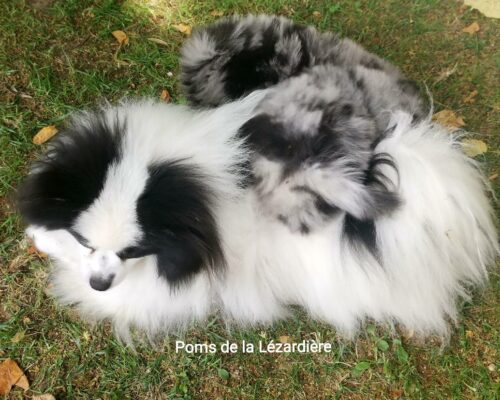
b – Socialisation to all types of dogs
(puppies, young, adults, seniors, small and large…)
The puppy must learn the rules of canine society. The earlier he learns to communicate respectfully and understand the codes of his peers, the more balanced and comfortable he will be in his interactions.
Until around four months old, a puppy goes through a particularly favorable period for exploration. It is naturally curious and open to new experiences. This is therefore the ideal time to introduce it to different types of dogs: calm, playful, older, and of varying sizes.
After four months, a phase known as “fear” may appear. During this period, any new element can be more overwhelming. It is then important to continue the visits, but always in a positive, gradual, and safe manner.
Well-socialized adult dogs are invaluable teachers. Up to about five months of age, they are generally more tolerant of puppies. They teach them boundaries through gentle, appropriate, and natural corrections. These interactions are essential for learning self-control.
At home, the puppy lives with its mother, siblings, and possibly other dogs. This group life provides a valuable foundation for its social balance.
On the other hand, cutting off contact with other dogs too early or multiplying negative experiences can hinder a puppy’s socialization. A puppy that doesn’t regularly meet other dogs risks losing its social cues and developing fear or reactivity later in life.
Progressive, varied and positive canine socialization is one of the pillars of a calm and well-adjusted adult dog.
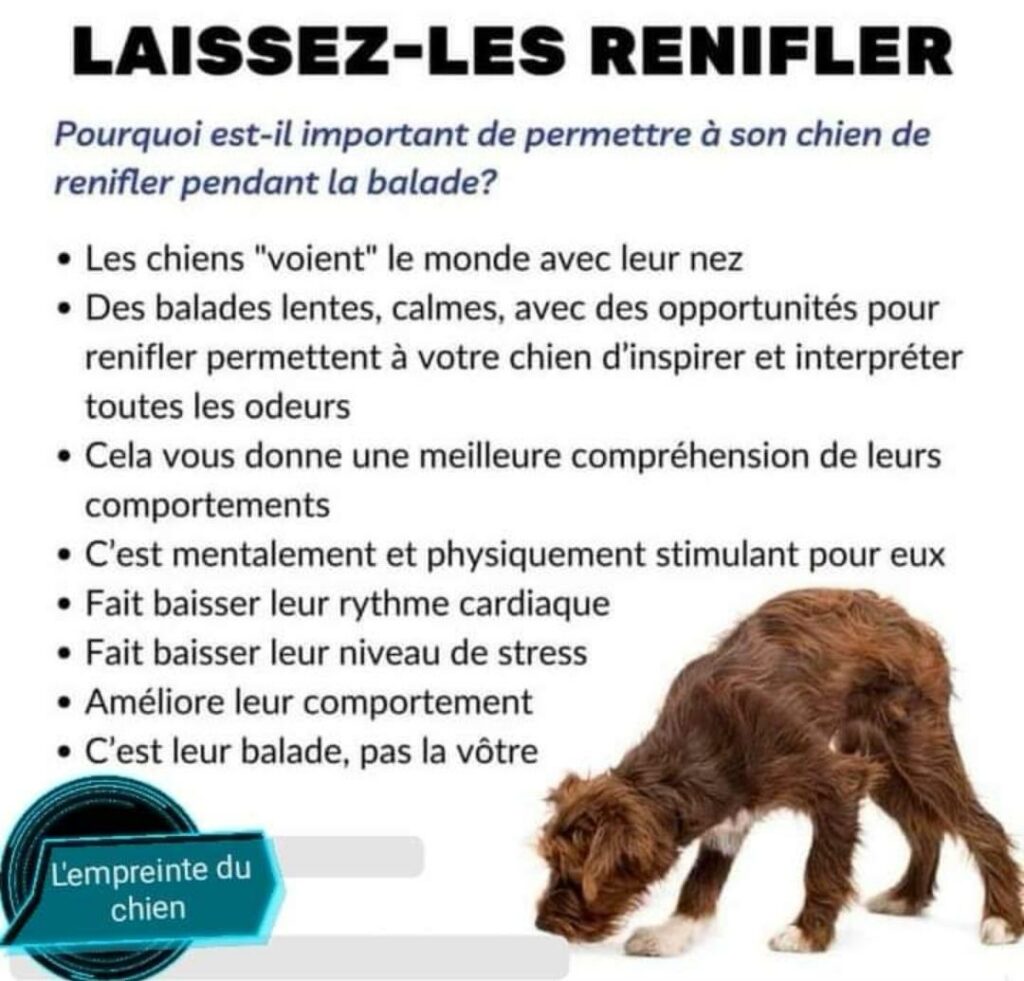
By L’empreinte du chien (facebook)
c – Socialisation with other animal species
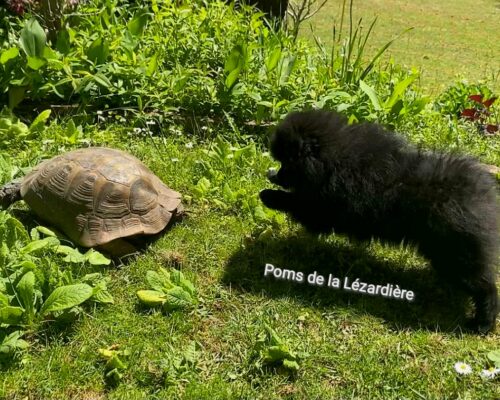
The puppy should be gradually accustomed to meeting other animal species. This will allow it to later live peacefully with them on a daily basis or to interact with them during walks, holidays or visits.
The earlier these encounters take place, in a safe and positive environment, the more natural they will be for him in adulthood.
At home, puppies are quickly introduced to different animals: cats, birds, horses, sheep, goats and many others depending on the environment. These early experiences teach them to observe, respect and adapt their behavior.
It is important that these introductions take place calmly, under supervision, and without excessive excitement. The puppy must understand that each species has its own codes and that gentleness is essential.
Proper socialization with other animals helps to avoid chasing, fearful or aggressive behaviors linked to unfamiliarity.
d – Socialisation to all types of humans
(babies, children, teenagers, adults, elderly people…)
The puppy needs to be accustomed to meeting people of varying ages, sizes, and attitudes. Each individual moves, speaks, and interacts differently: the more diverse and positive these experiences are, the more confident and sociable the dog will become.
Encounters with children should always be supervised. It is essential to explain to the child what they can and cannot do: do not shout, do not run towards the puppy, do not squeeze it too tightly, do not disturb it when it is eating or sleeping.
The puppy, for its part, learns to manage its excitement and adopt appropriate behavior.
Any negative experience can leave a lasting mark on one’s memory. That’s why initial encounters should be calm, gradual, and well-structured.
It is also important to get him used to seeing people wearing hats, glasses, long coats, using canes, strollers, or bicycles. All of these things can seem intimidating if they are not presented early and in a positive light.

By L’empreinte du chien (facebook)
e – Socialisation to society
(in the city, in the countryside, in cars, in parks, train stations, elevators…)
When a puppy leaves its first home—that of its mother and the breeder—it hasn’t yet seen or heard everything. The outside world is vast, varied, and sometimes awe-inspiring..
Socialization must therefore continue within his new family.
It is important to gradually introduce him to your environment: the street, the sidewalks, the traffic, the urban noises, the transport, the shops, but also quieter spaces like the countryside or parks.
Each place brings new stimuli: sounds, smells, movements, different surfaces (asphalt, grass, gravel, stairs, elevators…). All these experiences enrich his understanding of the world.
However, the progression must be adapted to their age and sensitivity. Too much intensity or sudden exposure can cause anxiety.
Take it step by step. Observe your puppy. If he hesitates, reassure him without forcing him. The goal is for him to associate these discoveries with positive experiences.
A puppy that is well socialized to “life in society” will become a dog capable of accompanying you everywhere, calmly and confidently.

By L’empreinte du chien (facebook)
3 – Maintaining focus amidst distractions
During your walks, it’s important to limit unsolicited interactions with strangers. Too much petting or external stimulation can lead your puppy to develop the habit of approaching everyone, even without your permission.
Learning from others is often more difficult than learning from yourself. You are your puppy’s role model and point of reference. Yet, some people take it upon themselves to pet him without asking your permission.
These actions may encourage him to jump around, get excited, or ignore your requests. You will then find it more difficult to refocus and calm him down.
It is therefore essential to anticipate and manage these situations.
If your puppy stares at someone or something, calmly say,
“Leave it,” then praise him when he looks away.
At the beginning of training, you can reinforce this with a small reward.
The goal is for him to understand that it is you who authorizes — or not — the interaction.
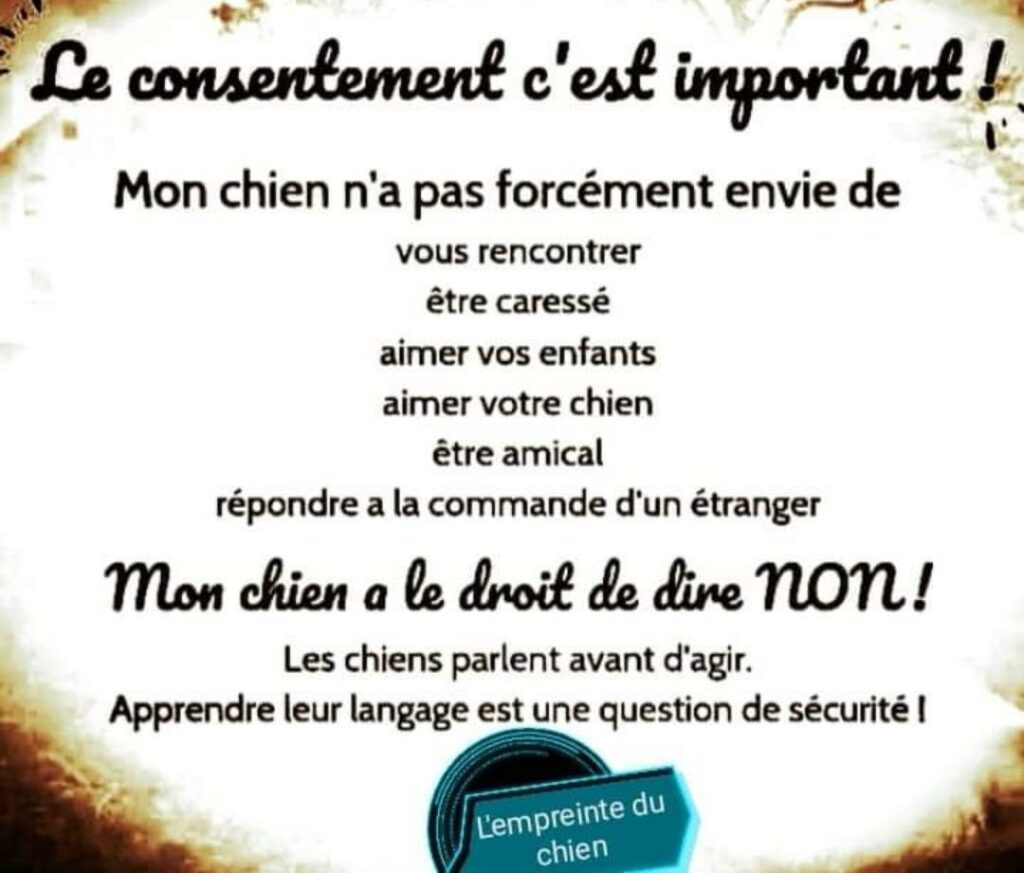
In the past, training was primarily based on strict obedience. The dog had to perform without its feelings being truly taken into account. Today, we know that a dog communicates and has the right to express discomfort.
A growl isn’t a “fault,” but a signal.
It indicates discomfort or a boundary.
Our role is to learn to read these signals and to protect our dog when necessary.
Your puppy has the right not to want to be touched.
It is up to you to enforce this limit.
If children rush to pet it, intervene calmly. Explain the rules: ask permission, approach gently, don’t shout, don’t squeeze.
By protecting your puppy, you strengthen its trust in you. It understands that you are its guide and its safety net.
A dog that feels supported will not need to assert itself through fear or aggression.
What other learning methods are there? Who created them? What do they teach?
4 – Motivation is the key to a successful education.
Teaching your dog to give something up means asking him to stop an activity he often finds very enjoyable. It’s therefore essential to offer him a motivating alternative in return.
You can ask him to stop digging a hole in the garden, chasing a cat, or jumping on guests… by offering him an activity or reward that is more interesting to you.
To give up is to win.
The puppy needs to understand that giving something up can bring him a benefit: a treat, a toy, a caress, a moment of play, or your attention.
The “leave it” command is just as important as a basic command like “sit” or “stay.” It allows you to redirect your puppy when it is in an overly emotional state (excitement, frustration, fear, agitation, etc.).
The goal is not to frustrate him, but to teach him to control himself gradually.
By using what truly motivates him, you reinforce his learning in a positive and lasting way. A motivated dog learns faster… and with pleasure.
5 – Use mealtimes to work on learning (short sessions).
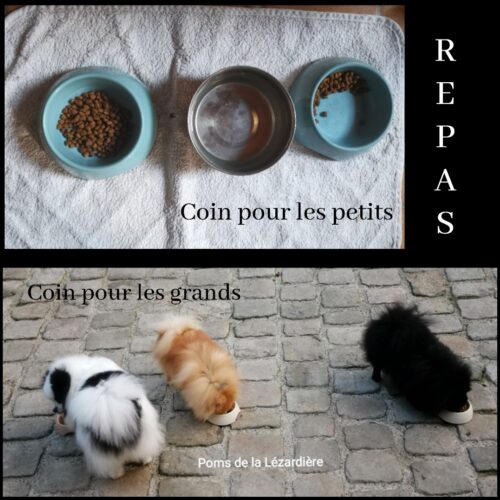
Mealtimes are an excellent teaching tool: your puppy is naturally motivated and attentive. It’s therefore an ideal time to reinforce basic training.
Before putting down the food bowl, take a few kibbles and work briefly:

The sessions should be short (1 to 2 minutes maximum), dynamic, and positive. The goal is to maintain motivation without generating frustration.
Once the exercise is finished, place the food bowl on the floor. The puppy should remain calm and wait for your signal.
Always use the same release word, for example:
“bon appétit” or “à table”.
This word clearly indicates the end of the exercise and permission to eat.
Consistency is essential: the same word must always correspond to the same request.
One order = one word = one precise action; this facilitates rapid and lasting learning.
6 – Reinforce obedience on each outing
Every walk is a learning opportunity.
Take advantage of outings to practice the exercises learned at home:
“sit”, “heel”, “stay”, recall…
Even outside, the rules remain the same. Consistency between home and outings is essential.
Walk your puppy off-leash only in safe and authorized areas.
If this isn’t possible, use a long leash to give it some freedom while still maintaining control.
Between 2 and 3 months old, puppies naturally tend to follow their humans. This is an ideal time to work on recall and strengthen your bond.
A puppy needs to expend energy: running, exploring, sniffing…
A dog that has had physical and mental exercise will be calmer when it returns home.
A successful outing combines physical exertion, mental stimulation and a reminder of the rules.
.
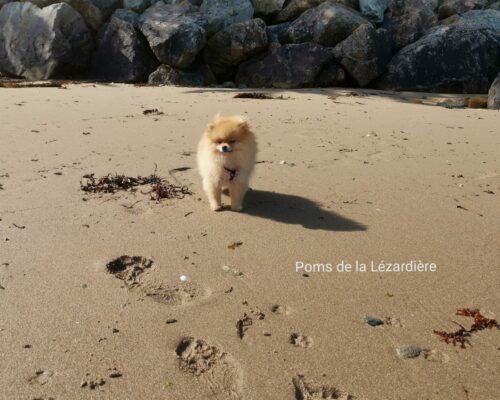
The choice between a collar and a harness depends on the puppy, its morphology and its level of learning.
Direct-Vet.fr
Puppy socialisation
Video explanation by Dr Charlotte RENARD
Consulting veterinarian for Direct-Vet.fr
More information
Potty training is an essential step in the well-being of the dog and the family.

