Morphology of the Pomeranian Spitz
I – Skeleton
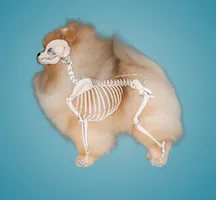
reference : ampomclub.org
The skeleton is a system of bony levers operated by muscles anchored at crucial points in the bones.
The bones are connected to each other by joints which act as shock absorbers. Bones have a complicated structure that gives great stability while allowing movement. They are anchored by ligaments that allow a given degree of movement in specific directions.
Each joint is surrounded by a joint capsule which contains the joint lubricant, the synovial fluid.
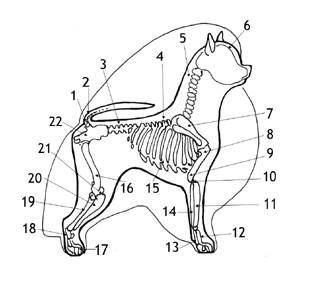
1. Coccygeal vertebra
2. Sacrum
3. Lumbar vertebra
4. Thoracic vertebra
5. Cervical vertebra
6. Skull
7. Scapula
8. Shoulder joint
9. Humerus
10. Elbow joint
11. Radius
12. Carp
13. Metacarpals
14. Ulna
15. Ribs
16. Femur
17. Metatarsals
18. Tarsus
19. Peroneal
20. Tibia
21. Grasset
22. Pelvis
reference : ampomclub.org
1.Description of the skeleton in the dog
From fetus to old age, the skeleton evolves and allows the dog to live its life in peace.
Skeletal formation in the puppy
In the belly of the bitch, the skeleton of the foetus is formed very late. At first, it is a simple cartilage. It is not until the last weeks of gestation that it finally ossifies and becomes strong enough to carry the weight of the puppy at birth! Bones are covered by a fibrous membrane called the periosteum.
Bone development
As the dog grows and its bones solidify, the periosteum is assimilated into the skeleton to strengthen it and the lower layers of the bone are absorbed and recomposed to prevent the bones from becoming too heavy and thick. Trabeculae line and consolidate the interior of the bone tube, allowing the bone marrow to play its crucial role in the body.
In order to grow, the bones need to be nourished by the elements contained in the blood. To enable these exchanges, a so-called “medullary” feeder canal is found in the long bones which are irrigated by arteries. This exchange also allows the metaphysis, i.e. the ossification of cartilage in the joints.
Adult skeletal structure
The general bone structure of the dog is structured like that of its primitive ancestors. However, the evolution of the different breeds has brought great variations! The number of bones is between 280 and 300, the size of which may vary according to the breed.
Dogs are technically plantigrades, i.e. they walk on their toes and not on the soles of their feet. Indeed, their body is supported by the 4 outer fingers of the 3rd phalanx.
Some bones are floating, like the last pair of ribs.
Last but not least, males have an extra bone: the penis bone!
2. The different roles of the dog’s skeleton
Several types of roles are fulfilled by the dog’s bone system:
Mechanical roles
As you can imagine, the skeleton has primarily a mechanical role. It serves to carry the soft tissues and support the body. It also provides leverage for the dog to move.
Finally, it helps to protect soft organs, such as the heart, lungs and brain.
Biological role
Bones are not just an impermeable structure. They contain calcium, phosphorus and other minerals necessary for the proper functioning of the body. There is a constant exchange between the bone tissue and the blood.
Moreover, it is inside the bones, in the bone marrow, that most of the blood cells are formed: the red and white blood cells, which are essential for the immune system.
Usefulness of cartilages
Cartilage is found in the joints. They increase the flexibility of the limbs and spine while absorbing shocks to prevent tissue and bone damage.
3.Pathologies linked to the dog’s skeleton
Bone-related health problems are not the most common, but there are a few to keep in mind:
- Growth problems: a diet insufficient in minerals and calcium in pregnant bitches or puppies can cause bone fragility in the long term.
- Hip dysplasia is an asymmetry of the head of the femoral neck and its socket. It is a genetic problem that primarily affects large breeds of dogs. It can become very disabling in the most affected individuals.
- Fracture: as with any vertebrate, a violent impact can lead to a fracture.
- Although quite rare, tumours can become implanted in a bone.
- Ageing and decalcification: older dogs metabolise calcium less well. This makes them more susceptible to fractures and bone pain.
référence : mouss-le-chien.com
II -Muscularity
1. Buttocks and muscles that move the hip joint
2. Latissimus dorsi
3. Brachiocephalicus (neck muscles)
4. Muscles that move the shoulder
5. Triceps (elbow extension)
6. Foot extensors
7. Chest
8. Muscles that flex the hip to move the leg forward
9. Biceps femoris and muscles that extend the leg
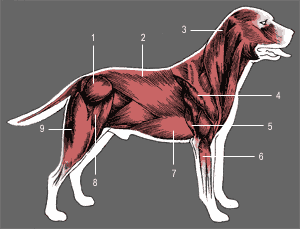
reference : ampomclub.org
1. Dogs have three types of muscles.
Cardiac muscles,
which are independent of the will and ensure that the heart beats at an appropriate rate. The dog’s heart beats faster than ours and oscillates between 70 and 120 beats per minute, depending on size and physical activity.
Smooth muscles:
Their involuntary contractions are intended to circulate substances (blood, air, food, fluids, etc.) in the body.
Skeletal muscles:
connected to the bones by the tendons, their contraction is subject to the will of the subject. They are made up of fibres attached to the nervous system which contract and relax in response to commands.
All muscles need protein to grow, contract and relax.
Canine muscles are divided into two categories:
the red muscles, which handle slow, long-lasting movements, such as posture, and the white muscles, which contract quickly and precisely, but for a short time.
2. Maintenance of the dog’s muscle mass
During a puppy’s growth, muscles develop a lot, which is why it is essential that puppies have the opportunity to run, walk or play. Each of these activities involves different muscles and helps their development.
Throughout its life, the dog needs to do sports: running, jumping, swimming, etc. It is useful for us, it is essential for them, because their health declines very quickly when the muscle mass no longer meets the animal’s needs!
Finally, for a well-maintained muscle mass, it is considered that the diet should never fall below 20% animal protein. Many brands of kibble go well beyond this figure and adjust the amount of protein to the age and health of the dog. This information must be contained on the package and is often also available on the internet.
3. Muscle diseases in dogs
Although muscles are not the primary cause of disease in dogs, complications can occur during life. The most common examples are
- Aging often leads to a loss of muscle mass. Maintaining a regular and adapted physical activity and choosing a special diet for seniors can slow down the process.
- After too much effort, dogs may suffer from muscle spasms. Medium-sized breeds are more affected. It is the infraspinatus and supraspinatus muscles in the back that are most often affected. There are treatments available.
- Muscle inflammation or myosytes. The best known is myositis of the masticatory muscles. It is either hereditary or due to an autoimmune disease. Treatments exist and must be implemented quickly to avoid serious complications.
- Centronuclear myopathy: an inherited disease that develops in the first year of life and then stabilises. In its mildest form, it causes only weakness and a characteristic gait but does not prevent the animal from leading a normal life.
- Muscular dystrophy: located on the X chromosome, it affects mainly males of the Golden Retriever, Rottweiler, Labrador, German Pointer or Cavalier King Charles. Symptoms appear as early as 2-3 months and lead to the progressive loss of all muscle functions: locomotion, feeding, breathing and heart function. As there is no treatment, the prognosis is poor and life expectancy is limited to 2 to 3 years.
référence : mouss-le-chien.com
III – Denture
Of a dog’s 42 teeth, six pairs are incisors and two pairs are canines. The remaining teeth are molars.
Traditionally, the most important teeth for the dog were the incisors and canines, as they helped the dog to tear and bite its food.

reference : peelagreen.fr
1. Incisors
The front teeth, which are the smallest, are called incisors. There are 12 in the dog’s jaw. These are shaped like a lily or a clover. They are called, by half jaw, pincer (the central incisors), middle (the next two), and wedge (the last lateral), the wedge being the incisor closest to the canine. Their size grows in this order. The larger upper corners resemble fangs, and the wear of their lobes gives an assessment of the dog’s age.
2. Canines
Also called “fangs”, the four canines are the strongest, most solid and longest teeth in the dog’s jaw. These are shaped like hooks or teeth and are used by carnivores to tear off their food. These sharp, protruding teeth are located between the incisors and molars. The fangs, when the canine growls, also serve to warn and threaten if the animal feels disturbed or threatened. Canines take their name from the Latin word canis, the dog.
3.Molars and premolars
There are 26 in the dog’s mouth (12 on top, 14 on bottom). Their size increases from the beginning of the arch to the carnassial (large molar) and then decreases. Located before the carnassial teeth, the premolars, known as precarnassials, are thin, sharp and saw-toothed.
After the carnassial teeth, the molars, also known as tubercular molars, are flattened, mamelonned and triturated.
The last molars in the dog, which are located at the bottom of the jaw, are rather flat (as in humans), to dilate and crush. These areas are more prone to cavities, especially if the dog is given sugary products, which is not recommended by vets.

reference : peelagreen.fr
The puppy’s teeth
The deciduous dentition of the puppy (milk teeth) consists of only 28 or 32 teeth (the number of premolars in the puppy being different according to the breed), with an identical number of teeth for each jaw, unlike the adult.
Per half jaw, the puppy has 3 incisors, 1 canine, and 4 premolars. The growth of milk teeth in puppies starts at about three weeks to one and a half months of age.
Then the baby teeth start to fall out after the fourth month, although the length of time it takes for the baby teeth to grow and fall out obviously varies between breeds and individuals. Gradually, the baby teeth will be replaced by adult teeth until the age of seven months.

reference : peelagreen.fr