
The endurance of the Pomeranian Spitz
Don’t judge a book by its cover!
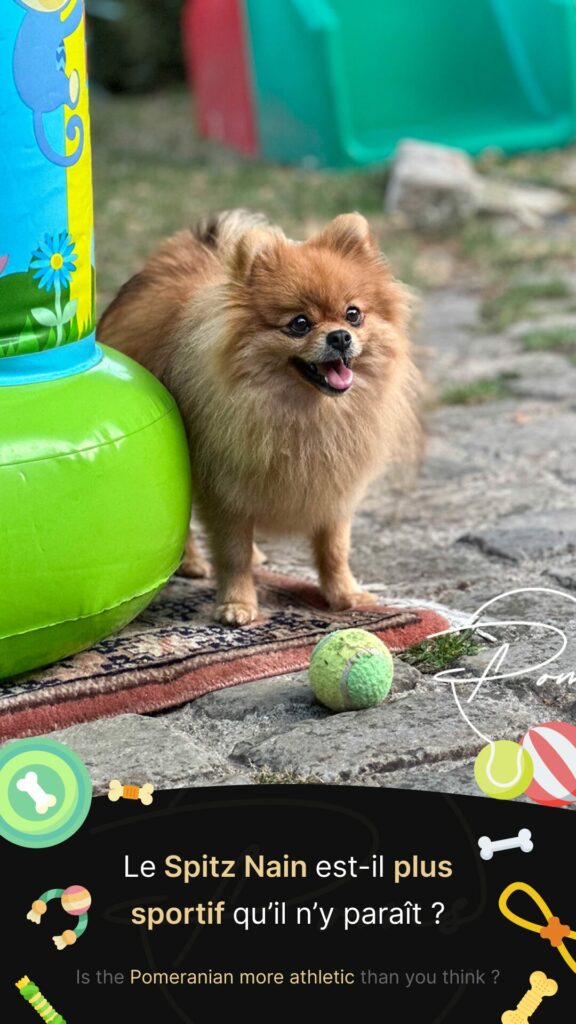
Although very small, the Pomeranian Spitz is very hardy. It can play for hours and do sports with you (why not running, brisk walking).
This is a lively, curious, and energetic dog that needs daily physical and mental stimulation to thrive. It possesses the spirit and stamina of large dogs.
Once home, he enjoys cozy moments; he can spend hours giving you kisses, hugs, and sleeping on the sofa next to you.
These are very gentle dogs that will bring a lot of joy and good cheer to your home.
Are they intelligent?
They stand out for their quick wit and ability to learn rapidly. They easily understand what is expected of them and often find solutions on their own, whether during training or play. Their good memory allows them to retain new commands after only a few repetitions.
But their intelligence isn’t limited to technical skills. They are also very good at sensing their owners’ moods and adjusting their behavior accordingly. This sensitivity makes them attentive and responsive companions, especially when a positive training approach is used.
A robust dog?
The Pomeranian Spitz is incredibly healthy! This small dog is not particularly fragile, unlike some other small breeds. They rarely get sick, and it’s not uncommon to see these dogs live for over 15 years.
Despite its cuddly appearance, it is an alert, courageous, curious dog that fully embraces its presence in the house.
It remains a primitive Spitz-type dog, which explains its vigilant, sensitive, and sometimes wary nature. Thousands of years ago, the ancestors of the Pomeranian were Spitz dogs, medium to large in size, found in the Arctic region. In Iceland, people used them as sled dogs, sheepdogs and hunting dogs in the far northern regions, used by Scandinavian tribes to hunt moose.
Attention, sa petite ossature demande de la vigilance car il peut se blesser involontairement notamment en cas de chutes ou de manipulations brusques.
Why is it important to walk your dog?
Walking your dog is essential and vital for its development. Beyond satisfying its need to expend energy, walks play a crucial role in socialization. They should be regular and daily.
Dogs need to exercise; it is essential because their health declines very quickly when muscle mass no longer meets the animal’s needs.
The walk must of course be adapted, according to its age, breed, condition, needs…. When the owner and the animal are well matched, the walk becomes a magnificent moment of pleasure and sharing.
How many times a day should it be taken out?
How to channel your energy and avoid boredom?
It is therefore important to offer him:
Daily walks,
even short ones, to explore their environment, expend energy, release accumulated energy, meet other dogs.
For the encounter to go well and for the experience to be positive, you must control the environment, your attitude, your emotions and above all you must read and correctly interpret the signals of the dogs.
Here are some rules to follow: organized meetings on neutral ground, dogs kept on a leash for the first time, do not force the meeting (they have the right not to like each other), remain calm and serene (they sense your emotions), do not remain motionless but walk around (remaining static can make the dog wary)…
Interactive games at home,
like treat-dispensing toys or snuffle mats, which stimulate his sense of smell and intelligence. The dog needs challenges.
games,
Knots, plush toys, noisy balls, a buffalo horn, to keep him occupied when he is home alone.
Play sessions with his owners,
such as games of hide-and-seek or throwing a ball (adapted to his size).
To propose new games,
exercise circuits in the house or garden…
Miniature agility exercises
perfectly suited to his liveliness and his desire to please.
The activity should not be intense but regular.
How many kilometers can he walk?
Outside temperature: 25°C = asphalt temperature: 51.6°C
Outside temperature: 30°C = asphalt temperature: 57.2°C
Outside temperature: 30.5°C = asphalt temperature: 61.7°C
An apartment dog?
The Pomeranian can adapt well to life in an apartment or a house. As long as it gets plenty of playtime during the day and enjoys long walks with you, your Pomeranian will be just as happy in an apartment as in a house.

