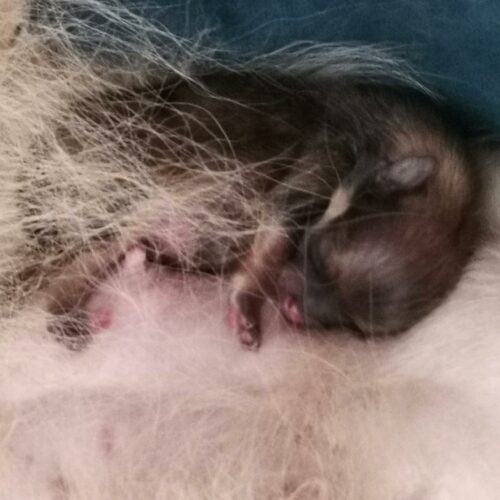
I was particularly keen to share this new topic with you:
The female dog during gestation and whelping
In an upcoming article, we will discuss monitoring puppies from birth, an equally essential step.
This chapter sheds light on the realities of being a breeder, as well as the essential attention and care that must be given to the female during this very special time.
If you are considering breeding your female dog, it is important not to idealize this experience. Gestation and whelping are natural processes, certainly, but they should never be taken lightly. Thinking that everything will happen on its own, without preparation or support, would be a mistake. Managing reproduction is a skill that must be learned, anticipated, and requires solid knowledge: it is a true profession.
In most cases, everything goes smoothly. However, unforeseen events can occur: complications, emergencies, a puppy’s fragility, or excessive fatigue in the mother. Being prepared, knowing how to recognize warning signs, and taking the right steps can make all the difference in preserving the lives of the puppies and their mother.
Being a breeder isn’t just about feeding and cleaning. It’s a deep and constant commitment. It means being present day and night, supporting each stage, monitoring, reassuring, caring for, stimulating, feeding, training, and socializing. It means giving your time, energy, and a lot of yourself.
Here’s a glimpse into the careful monitoring of a pregnant dog.



Gestation period
Managing Your Dog’s Pregnancy
The average gestation period for a female dog is 63 days from the day of mating, with a possible variation of plus or minus one week.
1. The Course of Gestation
Fertilization between the egg and sperm takes place in the oviduct (the end of the uterine horns).
Around day 11, the embryos penetrate the uterine horns.
They are then bathed in uterine milk until they attach to the uterine wall, via the placenta, around day 16: this is implantation.
The embryos then continue their development in the amniotic sac, connected to the mother by the umbilical cord.
Fetal growth intensifies particularly during the last third of gestation, between days 45 and 60.
Bone Development
Ossification begins around day 42
Ossification becomes clearly visible from day 50
2. Role of Hormones
Progesterone, secreted by the corpora lutea (ovarian follicles after ovulation), maintains the pregnancy.
The placenta also produces several hormones, including relaxin, which is essential for the relaxation of the peri-pubic tissues in preparation for whelping.
⚠️ Progesterone levels remain high in female dogs, whether pregnant or not: therefore, measuring progesterone levels cannot confirm pregnancy.
Why perform a pregnancy diagnosis?
Pregnancy diagnosis offers several major advantages:
-Confirming pregnancy
Allows us to distinguish between:
a truly non-pregnant female,
an early abortion,
a complete absence of pregnancy.
– Estimate the number of puppies
Adjust feeding at the end of gestation
Anticipate the risks of dystocia (difficult birth)
Detect the risk of singleton syndrome: a single puppy may continue to grow excessively, leading to a lack of oxygen and nutrients via the placenta, which can result in death in utero.
– Monitor proper development
Detect embryonic resorption
Identify growth abnormalities
Check fetal viability
Diagnostic Methods
1. External Changes
Abdominal enlargement: from the 4th week
Abdominal ptosis (dropped abdomen) at 2 months in the case of a large litter
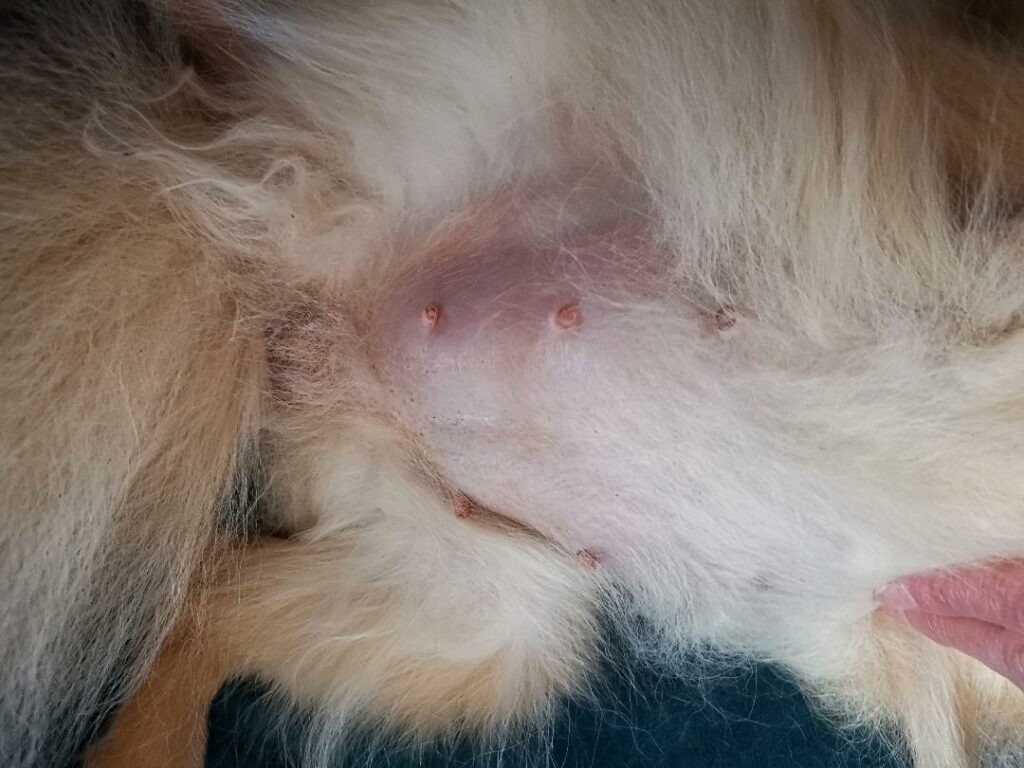
Mammary development: from 25 to 30 days
Swollen and engorged mammary glands
Visible umbilical cord
⚠️ Unreliable as it is also present in cases of pseudopregnancy
Serous or whitish vaginal discharge around 25–30 days
Infrequent
Does not indicate pyometra
When present, it is highly suggestive of pregnancy
2. Abdominal palpation
To be performed very gently: rough or repeated manipulation can induce abortion.
From day 21: Embryonic ampullae (oval shapes) can be perceived.
After day 35: The ampullae become large and merge → difficult to distinguish individually.
From day 45: Fetal bone landmarks become palpable again.
3. Auscultation
At the end of gestation:
Fetal heart rate: 220 to 240 beats/minute
This method is particularly useful in cases of post-term pregnancy or during parturition.
More difficult in large breeds.
Portable Doppler devices can detect the fetal heartbeat, but a common mistake is to confuse the fetal heartbeat with the flow of the maternal aorta.
4. Abdominal ultrasound (preferred examination)
Ultrasound is the most reliable and comprehensive method.
It allows for:
Early diagnosis
Assessment of fetal viability (visualization of heartbeats)
Detection of embryonic resorption
Estimation of the number of puppies
Monitoring of growth
📅 Recommended timing:
21 to 25 days after ovulation
or 20 to 23 days after mating
Without precise heat monitoring, it is advisable to wait 25 days post-mating to avoid a false negative.
5. Relaxin Blood Test
Relaxin is currently the most specific hormone for pregnancy in female dogs.
Secreted by the placenta from the 3rd week
Independent of the number of puppies
Two blood tests available
⚠️ Test can be performed from the 3rd week, but it is preferable to wait 25 days to limit false negatives.
In case of an early negative result, repeat the test one week later.
Limitations:
Does not indicate the number of puppies
Remains positive even in case of abortion
6. Abdominal X-ray
A late examination, useful for:
Precisely determining the number of puppies
Checking skeletal mineralization
📅 Visible from 45 days (beginning of mineralization).
In practice, X-rays are taken during the last week of gestation.
Contrary to popular belief, radiography cannot predict whether a puppy will be able to pass through the birth canal, except in cases of major developmental abnormalities.
References : Centrale Canine


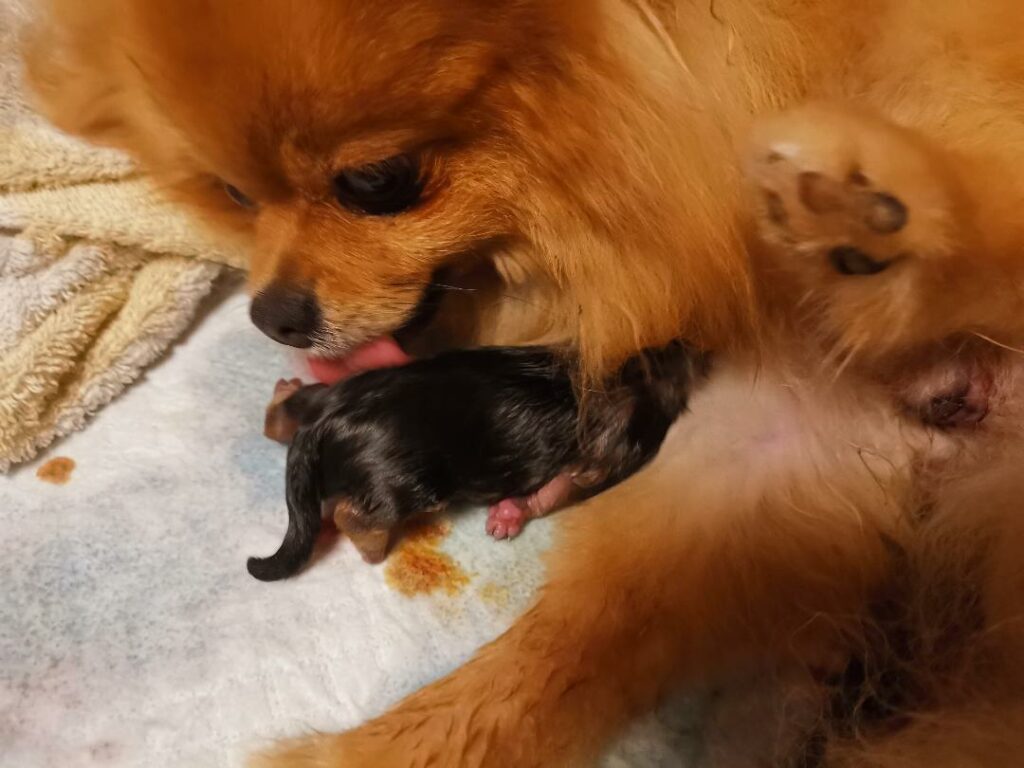
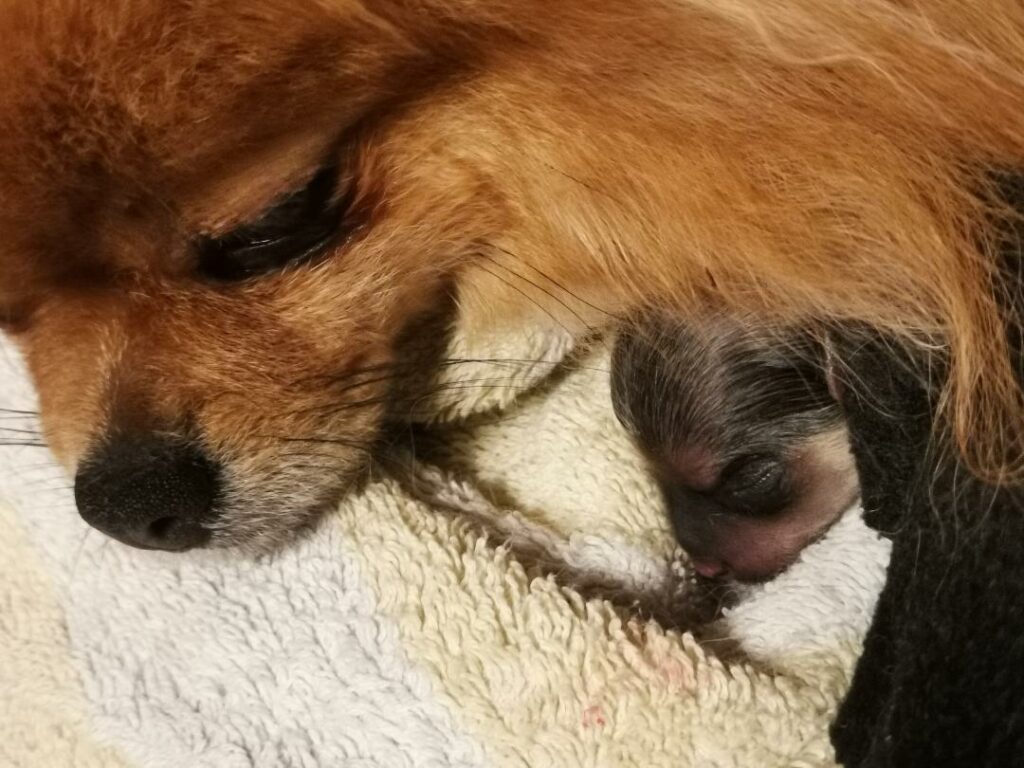
Whelping
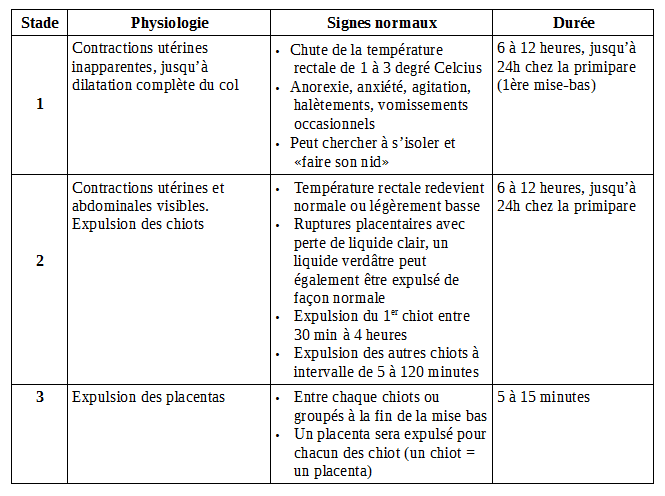
Reference : hopitalveterinairerdl.com
When will the puppies be born?
Several signs indicate that whelping is imminent. It’s important to be aware of them to calmly prepare for the arrival of the puppies.
Precursors
1️⃣ Drop in rectal temperature
This is a reliable indicator, provided it is monitored correctly.
Take the temperature morning and evening during the last days of gestation.
In the 24 hours before whelping, a drop of about 1°C is observed.
This drop is temporary (12 to 20 hours), so it’s important not to miss it.
2️⃣ Onset of lactation
The mammary glands begin to enlarge from the second month of gestation.
Their development is at its maximum about one week before whelping.
In:
First-time mothers (first litter): milk production generally occurs within 24 hours before whelping.
For women who have given birth before: colostrum can be present up to a week prior.
3️⃣ Vulvar swelling
The vulva gradually swells in the days leading up to delivery.
In first-time mothers, this sign may be subtle and appear only a few hours beforehand.
4️⃣ Cervical discharge
A clear, translucent, and colorless discharge appears at the vulva.
This is the latest sign, appearing just before the onset of labor.
How does whelping occur?
Whelping takes place in two main phases.
🔹 1. Preparatory Phase (Dilation)
Duration:
2 to 10 hours on average
Up to 36 hours in a first-time mother
Behavior:
Restlessness, anxiety
Searching for a quiet place to “make her nest”
Refusal to eat
Rapid panting
Sometimes vomiting
During this phase:
Uterine contractions begin.
They are involuntary and intermittent.
There are no visible abdominal contractions yet.
The cervix gradually dilates.
⚠️ It is essential not to stress or disturb the female dog. Stress can delay or stop whelping.
🔹 2. Expulsion Phase
Duration:
Generally less than 12 hours
Up to 36 hours in a first-time mother
Characteristics:
Uterine contractions are accompanied by visible abdominal contractions.
The first puppy often takes the longest to be born (up to 6 hours after the start of labor).
The average interval between births is 10 to 60 minutes.
At birth
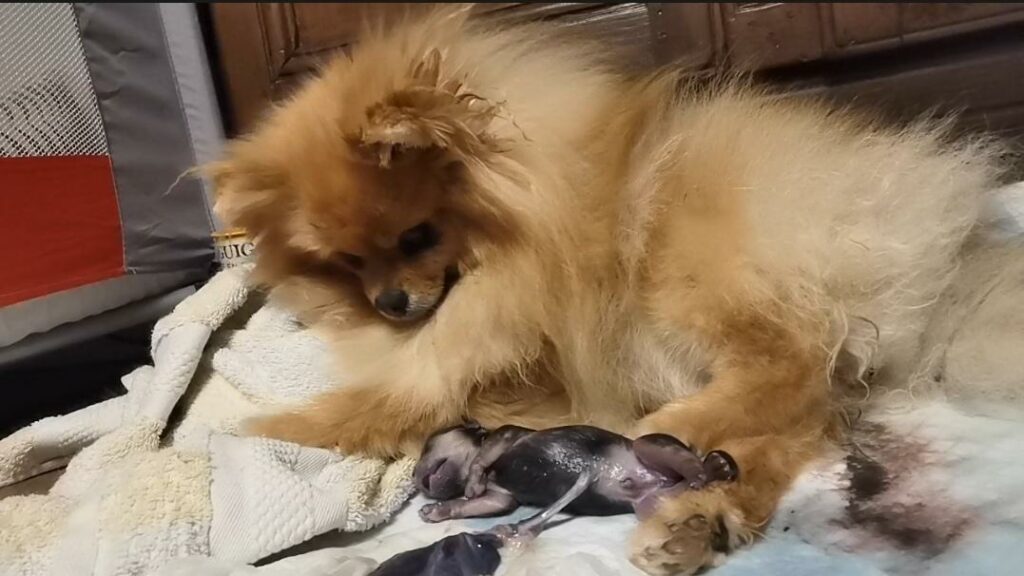
The puppies are enclosed in the amniotic sac:
It usually ruptures during expulsion.
Otherwise, the mother opens it immediately after birth.
If the sac remains intact and the mother does not intervene, you must rupture it within 2 minutes so that the puppy can breathe.
The mother:
Licks the puppy (respiratory stimulation)
Cuts the umbilical cord with her teeth
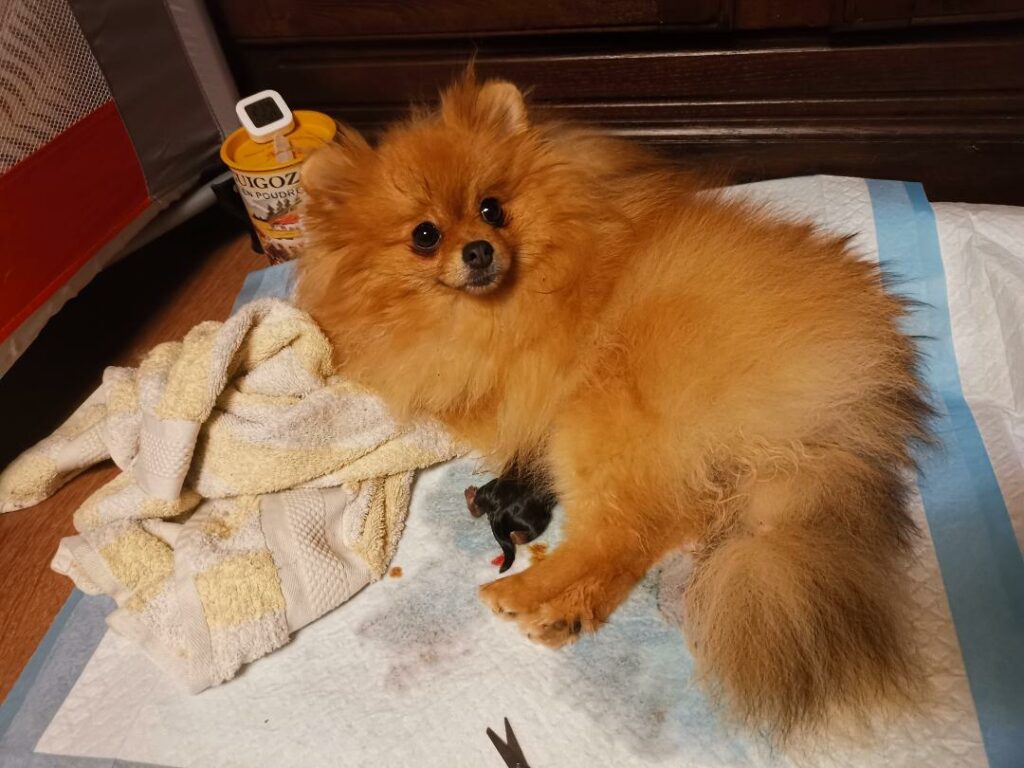
A few minutes after each birth, the placenta is expelled.
Contractions then become less frequent until the next puppy is born.
Preparing for Whelping
Planning ahead allows you to experience this moment more calmly.
Prepare:
A quiet place, sheltered from drafts
A suitable whelping box
Sufficiently high sides
Anti-crushing bars for large breeds
A clean blanket
An infrared lamp (ideal nest temperature: 28 to 30°C)
Clean towels
A thermometer
Disinfected scissors
Disinfected thread
Betadine®
The female dog must remain calm.
Your role is primarily to observe. Intervention is generally not necessary.
What to do if needed?
Should the umbilical cord be cut?
Normally not.
If after 15 minutes the mother has not severed it:
Tie it off with disinfected thread about 2.5 cm from the navel.
Cut approximately 1.5 cm after the ligation.
Disinfect the stump with Betadine®.
What to do if a puppy isn’t breathing?
Clear the airways (using a bulb syringe or nasal aspirator).
Rub the chest vigorously with a warm, dry cloth to stimulate breathing.
In most cases, this stimulation is enough to trigger breathing.
Green discharge: Is it normal?
Yes.
The green color is a pigment from the placenta.
It is normal during labor.
When to call the veterinarian?
Contact your veterinarian if:
The gestation period exceeds 65 days
More than 2 hours pass between puppies
Green discharge appears and no puppies are born within 6 hours
Your dog seems to be in abnormal pain (whining, heavy bleeding, lethargy)
The number of puppies delivered is not the expected number and contractions have stopped for 2 hours
After whelping: foul-smelling discharge (risk of uterine infection)
After whelping: trembling, rapid breathing, restlessness (suspected eclampsia).
Puppy Monitoring
Birth doesn’t mark the end of monitoring; quite the opposite. The first few days of life are a particularly fragile period where the breeder’s attention is essential.
🌡️ Temperature Control
Puppies don’t regulate their body temperature properly at birth. It is therefore essential to keep them warm and monitor their temperature regularly.
Physiological Reference Points:
At birth: approximately 35.5°C (95.3°F)
During the 1st week: approximately 36.5°C (97.5°F)
Around the 3rd week: approximately 38°C (100.4°F)
Hypothermia can quickly lead to weakness, refusal to nurse, and endanger the puppy’s life.
⚖️ Feeding and Weight Gain
Feeding must be carefully monitored from the very first hours:
Check that each puppy is nursing properly.
Make sure that none are left out.
Monitor the mother’s milk production.
Daily weight gain is a key indicator of good health.
➡️ Puppies should be weighed daily at the same time, and their weights recorded to track their progress.
A lack of weight gain, or even weight loss, should be a cause for immediate concern.
We will discuss feeding, monitoring, and neonatal care in detail in the next chapter.
References: Dr. Charlotte Renard’s blog, veterinary consultant for Direct-Vet
More information?
videos
In this video:
👉 What checks should be carried out by your vet to find out how many puppies the bitch is expecting?
👉 At what precise times should these pregnancy monitoring checks be carried out?
👉 When should pregnant bitches be rationed and wormed?
👉 How many litters of puppies on average can be born, depending on the bitch’s breed? Because the difference between a Yorkie and a Mastiff is huge!
👉 And lots of other questions and answers to certain preconceived ideas…
We talked about this with my veterinary colleague specialising in reproduction, Dr Juliette Roos-Pichenot, a partner at Anirepro, in the EVOLIA clinic. 👩🏻⚕️
In this video:
👉 What are the warning signs that a bitch is about to give birth?
👉 How often should puppies be born?
👉 How long can a give birth session last in total?
👉 What are the signs of a puppy stuck in an anterior position?
👉 Or a puppy stuck in a posterior position? 👉 And what can be done in each case?
👉 What do the bitch and her puppies do immediately after giving birth?
We talked about this with my veterinary colleague specialising in reproduction, Dr Juliette Roos-Pichenot, a partner at Anirepro, in the EVOLIA clinic. 👩🏻⚕️
Laura acts as midwife and, above all, provides moral support during the whelping of her dog Brumby. Four little puppies can’t wait to get out and discover the world!
In this video:
👉 What is the 1st step in caring for puppies as soon as they give birth?
👉 How should a bitch who has just given birth be cared for?
👉 What should puppies be checked for first to ensure they are healthy?
👉 What are the particularities of the bitch during whelping?
👉 And why is colostrum so important for puppies?
👉 Finally, what should you do if the bitch doesn’t look after her puppies?
We talked about this with my veterinary colleague specialising in reproduction, Dr Juliette Roos-Pichenot, a partner at Anirepro, in the EVOLIA clinic. 👩🏻⚕️